
A brief note on the word Edo
If you are visiting Tokyo for the first time, this is worth ten seconds. Tokyo was called Edo until 1868. It was a fishing village that became the seat of the Tokugawa shogunate in 1603, grew into what was probably the largest city on earth by the 1700s, and was renamed Tokyo, meaning "eastern capital," when the emperor moved there at the end of the shogunate.
So when a Japanese business is called something-ya with Edo in front of it, it is doing roughly what a London business does when it calls itself Olde. Except that in this particular case, the street it stands on has a documented reason to make the claim.
The land was given away in 1616
Tokugawa Ieyasu died in 1616 in Sunpu, having founded the shogunate that would govern Japan until 1868. The retainers who had served him in Sunpu were recalled to Edo, and three groups among them were granted land on this hill: the chugen, the kobito and the kagokata. Attendants, footmen, palanquin bearers. Not samurai of high rank. The people who carried things and opened doors.
Because they had come back from Suruga province, the neighbourhood was informally called Suruga-cho. Then in 1696, eighty years later, the district was formally renamed Mikumi-cho, "town of the three groups," for the express purpose of preserving the reason those men had been given the land.
Consider that for a moment. Someone in 1696 decided that the reason a piece of land had changed hands eighty years earlier was worth encoding into the name of the district, permanently.
And erased in 1965
The name lasted two hundred and seventy years. It survived the fall of the shogunate, the Meiji Restoration, the 1923 earthquake and the firebombing of Tokyo.
It did not survive April 1965, when a nationwide reform of Japanese addresses replaced old district names with a grid of numbers. Mikumi-cho became Yushima 3-chome. The slope kept its name, Mikumi-zaka, because slopes are not addresses. The town did not.
Two years later, in 1967, this inn opened on that slope, under the name Edoya.
About the name, honestly
We should be straight with you. The founder left no written record of why the inn was called Edoya. We cannot tell you it was a deliberate act of preservation, because nobody wrote it down.
What we can tell you is the sequence. This land was granted to men who came home to Edo. The district was renamed in 1696 so that fact would survive. That name was erased in 1965. And in 1967 a building went up on the same slope with Edo in its name.
Make of it what you like. We find it hard to read as a coincidence.
The decision to go backwards
The more interesting decision in this inn's history is more recent, and we do know the reasoning behind it.
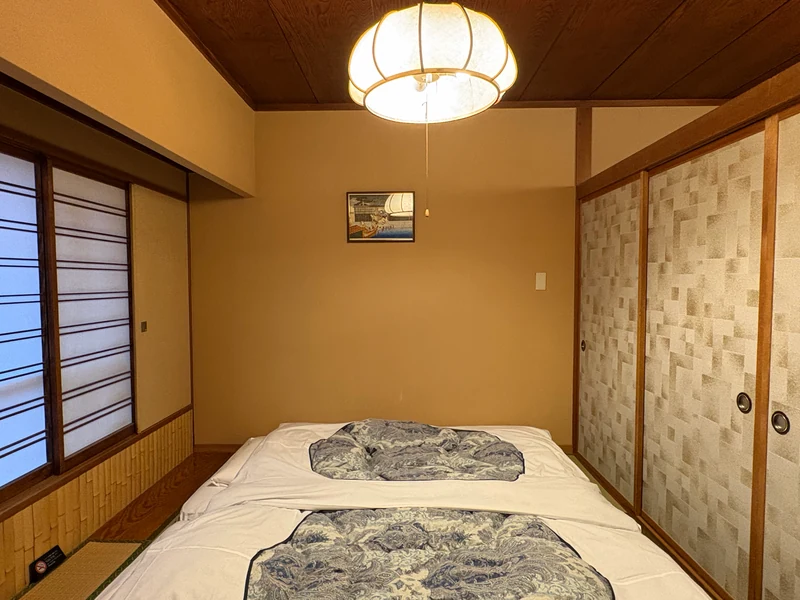
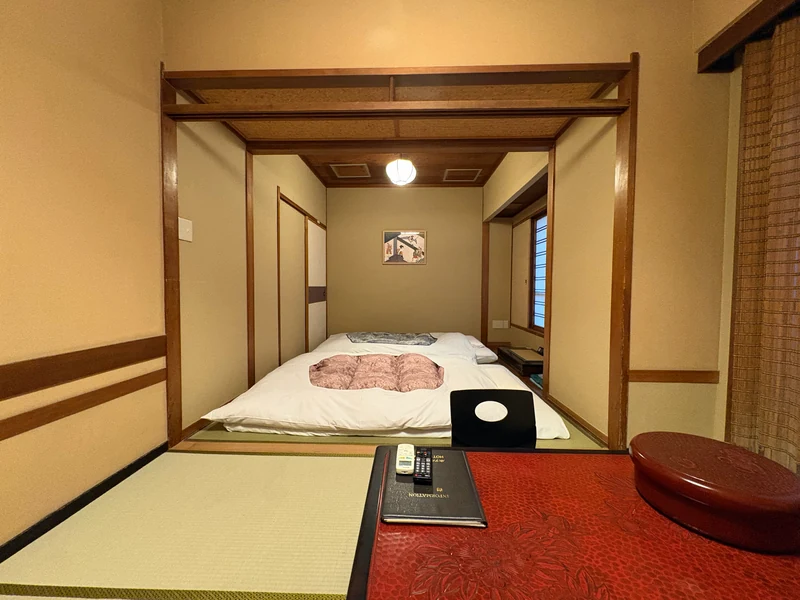
About twenty years ago, Hotel Edoya converted from mostly Western-style rooms to mostly tatami rooms. Beds out, futons in.
At the time, the rest of the Japanese hotel industry was moving in exactly the opposite direction. Traditional inns were installing beds, replacing tatami with carpet, and rebranding as hotels, because that was what the domestic market wanted. This inn went the other way.
Twenty years later, most of the people who stay here are visitors from overseas, and a good number of them are here specifically because they want to sleep on a futon on a tatami floor at least once. Whether the decision was farsighted or simply stubborn is not for us to say. But the inn as it exists now stands on it.
- Opened
- 1967
- Address
- 3-20-3 Yushima, Bunkyo-ku, Tokyo 113-0034, on Mikumi-zaka slope
- Registration
- Government-registered international tourist inn
- Rooms
- Mainly Japanese-style with tatami. Western rooms also available
- Bath
- Open-air baths and sauna on the sixth floor, separated by gender
- Dining
- Kosetsu, a Japanese restaurant in the basement. Hand-cut soba. Breakfast included
- Nearest station
- Yushima, Tokyo Metro Chiyoda Line, about 5 minutes on foot
The bath on the sixth floor
If there is one thing in this building worth describing, it is the bath.
There are open-air baths and saunas on the sixth floor, separated by gender. The building sits on a hill and the bath sits on top of the building, so when you are in the water there is nothing above you but sky.
The rooms nobody advertises
Two things have survived in this building that are difficult to put in a brochure.
There is a room for mahjong on the sixth floor, available by reservation, still in use. And there is a room that used to be a tea ceremony room, now sometimes used for guests who want to try on a kimono. This part of Yushima was once a geisha district, which is probably not unrelated.
Neither of these is a selling point in the way an open-air bath is. But when a building has been running for fifty-nine years, rooms like this accumulate. We have not removed them, and that is about as close to a statement of character as this inn makes.
Edo was the name of Tokyo before 1868. The suffix "-ya" indicates a shop or an establishment. So Edoya means roughly "the house of Edo."
The street the inn stands on, Mikumi-zaka, has carried a piece of that history in its name since 1696.
It opened in 1967, so fifty-nine years as of 2026. The building is from that period and has not been rebuilt, though parts of it are renovated most years.
No, and we would rather say so. The building dates from 1967 and the bathrooms inside the guest rooms are not modern. Guests write about this in reviews and they are right.
What we do have is tatami, an open-air bath above the city, a quiet hill, and staff who have been doing this for a long time. If those matter more to you than a new bathroom, you will be happy here.
A Japanese registration scheme under the Hotel and Ryokan Development Act, for accommodation meeting standards for receiving overseas visitors. Hotel Edoya has held it since opening.
- The history of Mikumi-zaka and Mikumi-cho: the recall of Ieyasu's retainers in 1616, the formal renaming in 1696, and the address reform of April 1965. Bunkyo City records
- Opening year and registration status. Hotel Edoya official site
- Conversion to tatami rooms, the mahjong room and the former tea room: interview material published by the Tokyo branch of the Japan Ryokan and Hotel Association, and the current state of the building
Five minutes from Yushima Station, walking distance to Ueno and Akihabara.